手册 v0.1.0 · KaiderBooks v2.0.0 · 2026-07-20
Quote to cash
In one sentence
Send a quotation, convert it to an invoice once the customer accepts, post the invoice (which writes the journal for you), then record the payment against it — no manual journal entry anywhere in the chain.
1. The chain at a glance
| Step | You do | The system does | Document status |
|---|---|---|---|
| 1 | Create a quotation | Saves a draft; nothing hits the ledger | Draft |
| 2 | Click Send | Records it as sent | Sent |
| 3 | Customer agrees — click Accept | Marks it accepted | Accepted |
| 4 | Click Convert to invoice | Builds a draft invoice from the quote lines and jumps to Invoices | Quotation: Converted |
| 5 | Review, then Send & Post | Assigns the formal invoice number and posts the journal | Sent |
| 6 | Money arrives — record a receipt | Posts the receipt journal and updates the invoice | Partial / Paid |
Step 5 is the point of no return
Before Send & Post an invoice is a draft you can freely edit or delete. Once posted it has a formal number and a journal behind it, so it can only be voided (which posts a reversing journal) — never edited.
2. Quotations
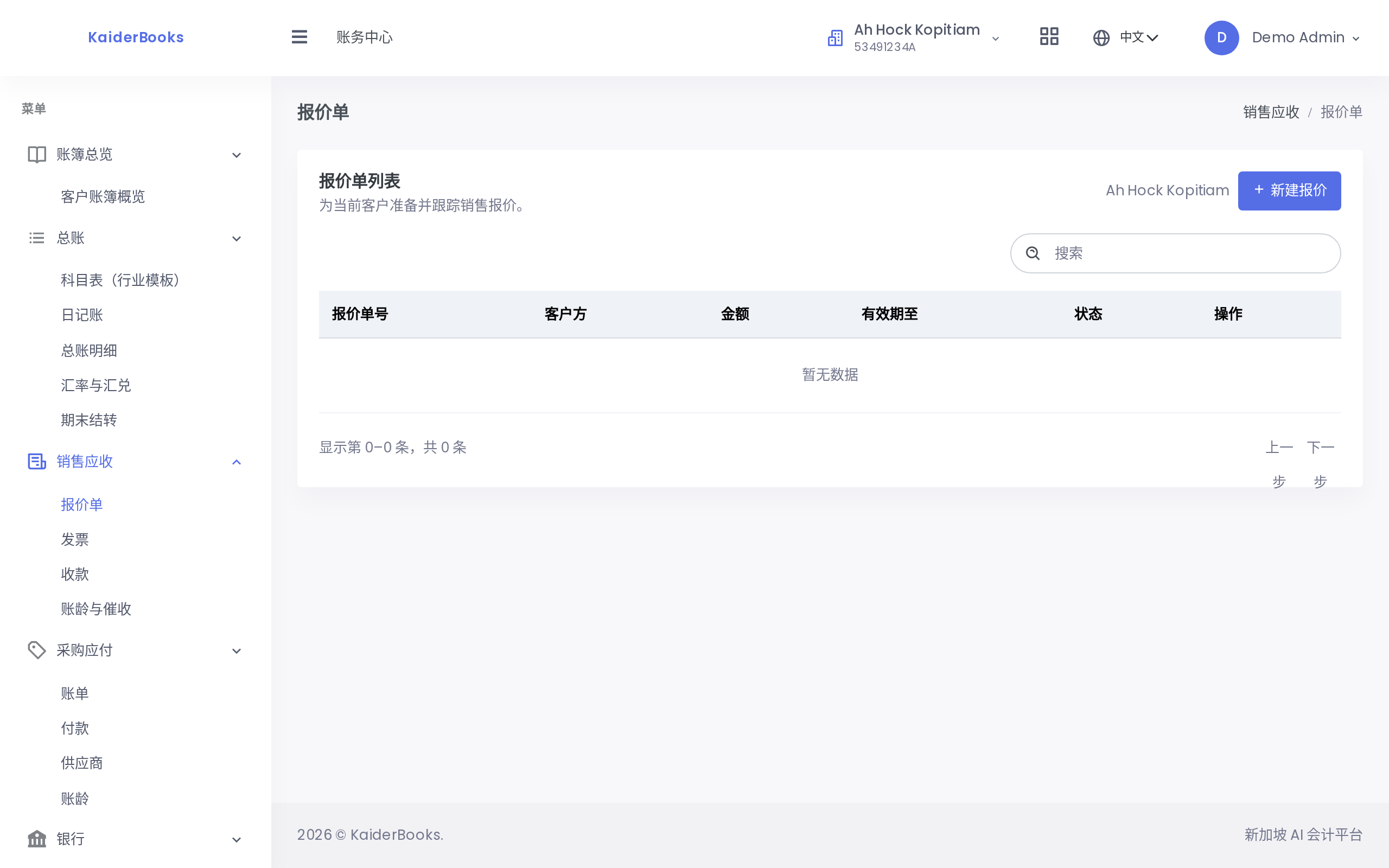
Pick the customer, set the issue date and validity date, then add the line items. Available actions depend on status:
- Draft — Edit / Send / Delete
- Sent — Accept
- Accepted — Convert to invoice
- Converted / Expired — no actions
3. Raising an invoice
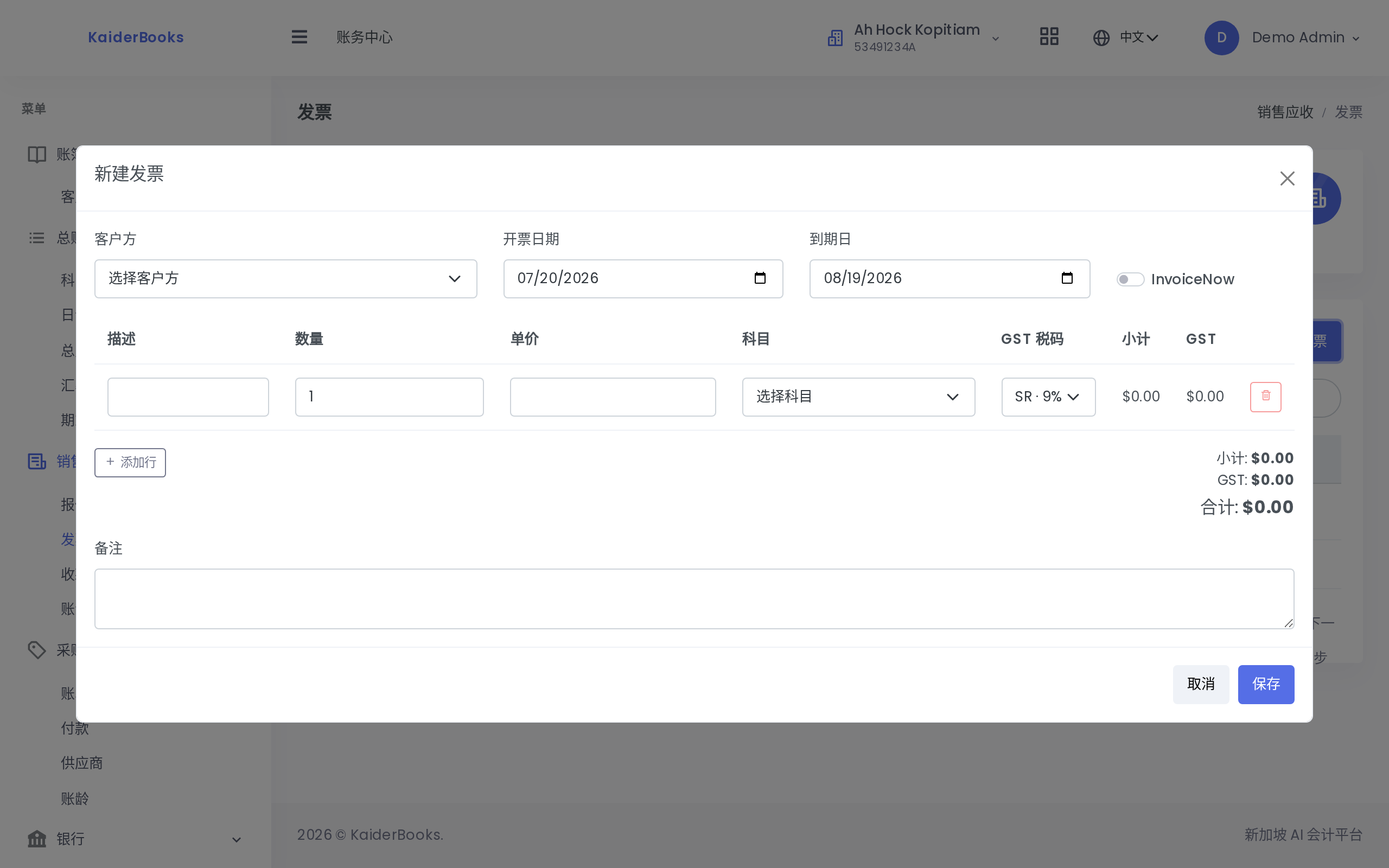
1
Pick the customer first; create one under Contacts if the list is empty
2
Fill one line per item; enter unit price in dollars, stored in cents
3
SR = standard-rated 9%, ZR = zero-rated, ES = exempt
| Field | Notes |
|---|---|
| Customer | Only contacts of kind customer under this client are listed |
| Issue / due date | The due date cannot precede the issue date; it drives aging buckets |
| Line items | Description, quantity, unit price (dollars), revenue account, GST code |
| InvoiceNow | Marks the invoice for the Peppol network (demo flag for now) |
Subtotal, GST and total update live at the bottom right. For "2 × $150 at SR": subtotal $300.00, GST 9% = $27.00, total $327.00.
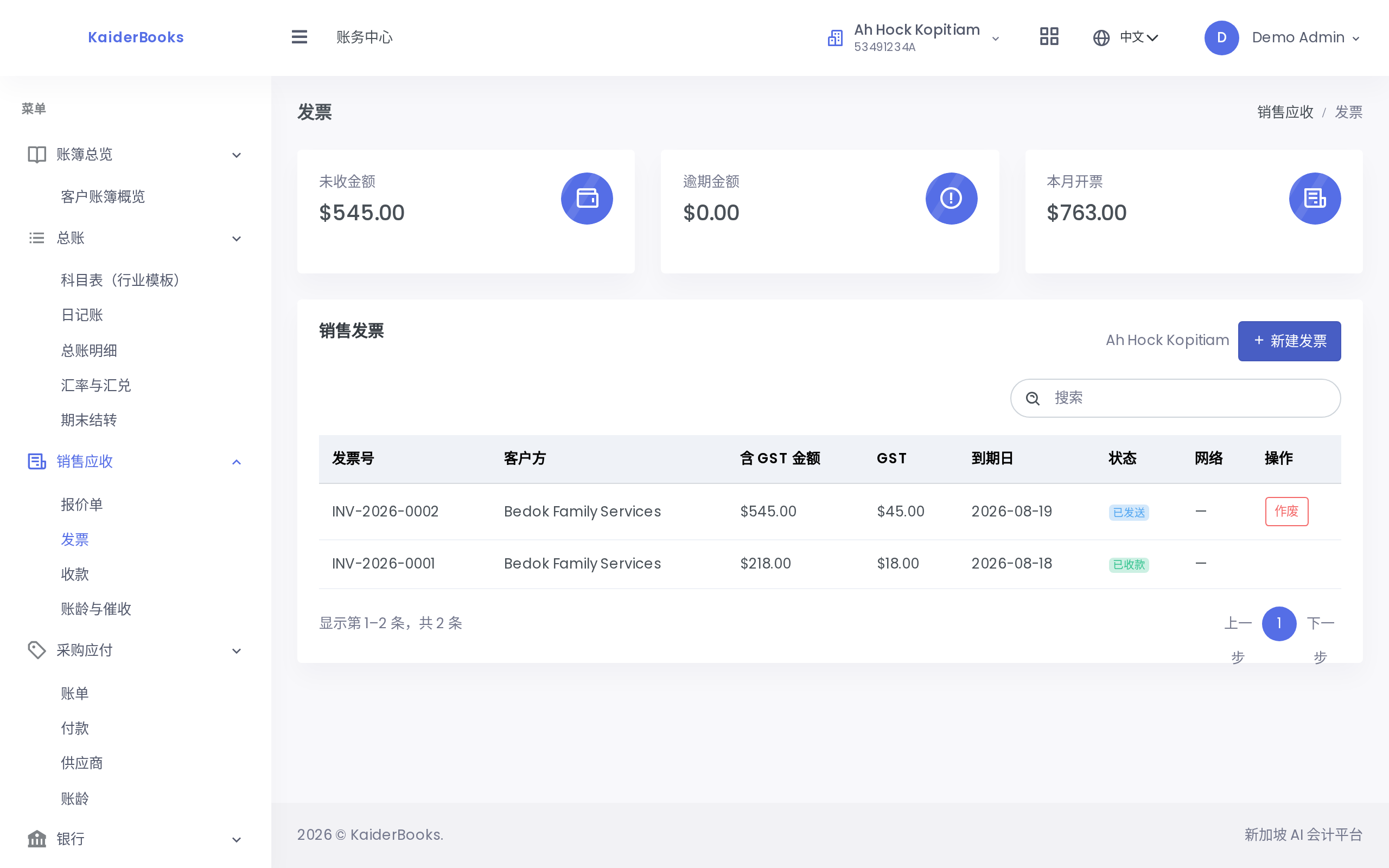
The three cards above the list show outstanding, overdue, and invoiced-this-month totals.
The journal produced by Send & Post
For a $436.00 invoice (subtotal $400 + GST $36):
| Account | Debit | Credit |
|---|---|---|
| 1100 Trade receivables | 436.00 | |
| 4000 Sales revenue | 400.00 | |
| 2200 GST control (output) | 36.00 |
Debits equal credits, the journal is posted immediately, and the figures reach the reports right away.
4. Receipts and allocation
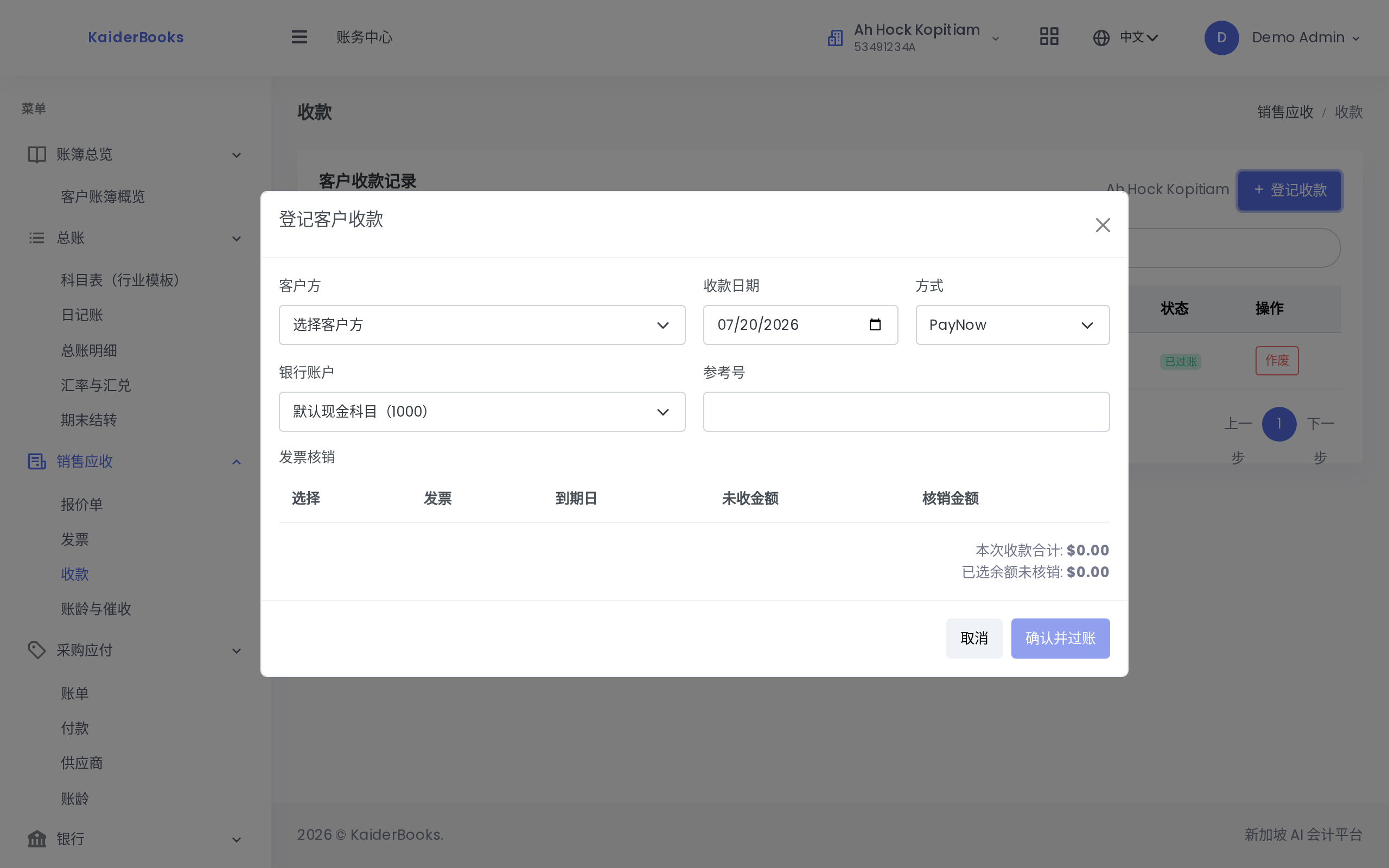
1
Choosing the customer lists all their unpaid invoices below
Choosing a customer lists every sent or partially paid invoice they have. Ticking one fills the amount with its outstanding balance; lower it for a partial payment.
| Field | Notes |
|---|---|
| Method | PayNow / Bank transfer / Cheque / Cash / Card |
| Bank account | Leave empty to use the default cash account (1000) |
| Reference | The bank reference — useful later during reconciliation |
Two totals sit at the bottom: the receipt total (sum of ticked amounts) and the unallocated balance. If the latter turns red you have over-allocated and the confirm button stays disabled.
After posting, the invoice's paid amount updates, its status becomes Partial or Paid, and AR aging drops accordingly.
Recorded the wrong amount?
Click Void on the receipt: the system reverses the receipt journal, rolls the allocation back, and returns the invoice to Sent. Every original record stays for audit.
5. Aging dashboard
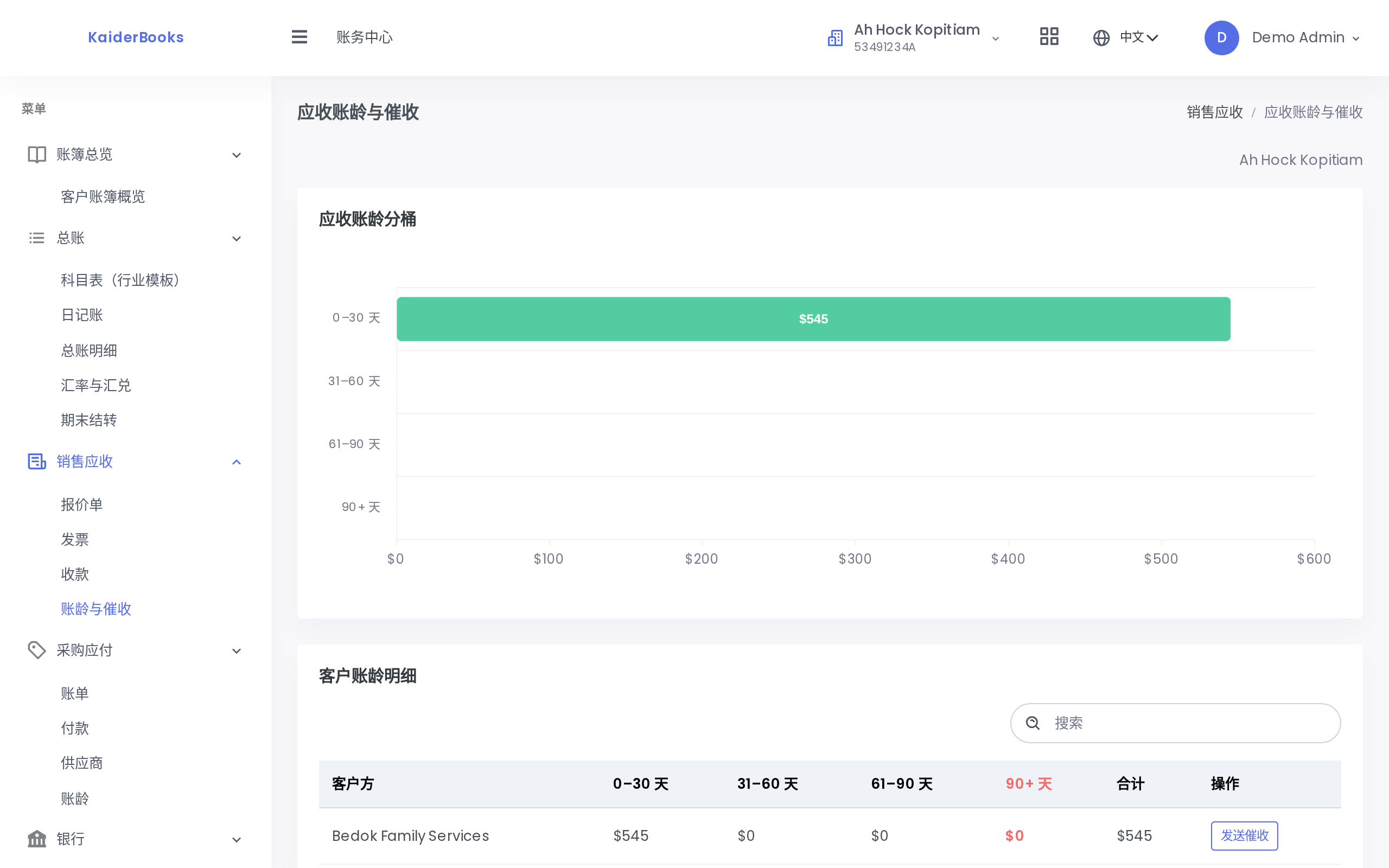
One row per customer, split into four buckets by days overdue (0–30 / 31–60 / 61–90 / 90+). Rows with anything in 90+ turn red, and a reminder button sits on the right.
The data comes from invoices in Sent or Partial status, so a customer disappears from the list once fully paid.
Next: Purchases and payments →